
Checking Criminal History in Fort Dodge
Fort Dodge has more official city-level record channels than the county's smaller communities. The right choice depends on whether the reader wants a police report, recent call information, an arrest product, a booking record, or a filed case. Use an incident number, approximate date and time, public location, and record type whenever those details are known.
- Review the Fort Dodge Police Calls for Service interface when the question concerns very recent public activity. Treat a listing as preliminary, not as proof of an arrest or conviction.
- Request the incident or arrest report from Fort Dodge Police through its online chapter 22 form, in person, or by mail. Describe the exact item and preferred format.
- Use the FDPD Local Arrest History form only for the narrow Webster County records that Fort Dodge Police maintains. Read its exclusions and disposition warning.
- Contact Webster County Jail if the event led to booking or if a booking photograph or custody status is sought. The jail and police share a building but remain separate custodians.
- Search Iowa Courts Online for a filed prosecution and final disposition. Use Iowa DCI only when an Iowa-wide, fingerprint-supported history product is needed.
Fort Dodge Criminal Record Layers
A single Fort Dodge event can create several records without creating one merged file. Police write the event report. Webster County Telecommunications controls dispatch or CAD material. The county jail makes the booking entry. Iowa District Court records the prosecution, and DCI may add a qualifying fingerprint-supported cycle to the state history. Each source can be accurate while showing a different stage.
| Fort Dodge record | Official custodian | What it answers |
|---|---|---|
| Incident or arrest report | Fort Dodge Police | What city police documented about the event and arrest |
| Dispatch or CAD record | Webster County Telecommunications | Call and dispatch activity subject to redaction |
| Booking record or photograph | Webster County Jail | County intake, custody, hold, bond, release, or transfer |
| Filed criminal case | Iowa District Court | Filed charge, docket events, disposition, and sentence |
| State history | Iowa DCI | Releasable Iowa fingerprint-supported history |
This split is the main Fort Dodge access rule. Asking the police counter for a court disposition or jail mugshot can delay a request because those items belong to other offices.
The tight downtown layout can make the split seem less clear. The county courthouse, Law Enforcement Center, county attorney, and state supervision offices are all in Fort Dodge, but physical proximity does not change legal custody. Naming the exact record keeps a city request at city altitude and prevents an incident report from being confused with a booking or court file.
Fort Dodge Police Department Records
The Fort Dodge Police Department operates at 702 First Avenue South. Its administrative line is 515-573-1424, with office hours Monday through Friday from 8:00 a.m. to 4:30 p.m. The city also lists 515-573-1426 as a main number, 515-573-2323 for nonemergency dispatch, and 911 for emergencies. Administration, Uniform Patrol, and Criminal Investigations are named divisions.
FDPD may release basic date, time, and location facts unless disclosure would jeopardize an investigation. When no arrest was made, suspect information is redacted. Some supporting investigative material may require subpoena. An incident report may be available the same day, but the city also publishes a longer outer response period for requests that need review or production.
Fort Dodge Police Record Request Form
The current Fort Dodge online chapter 22 form is available at any hour, while staff review requests in regular business hours. Its visible controls require a department choice, record-request details, and acknowledgment of chapter 22 and timing terms. The captured form below shows the official entry point.
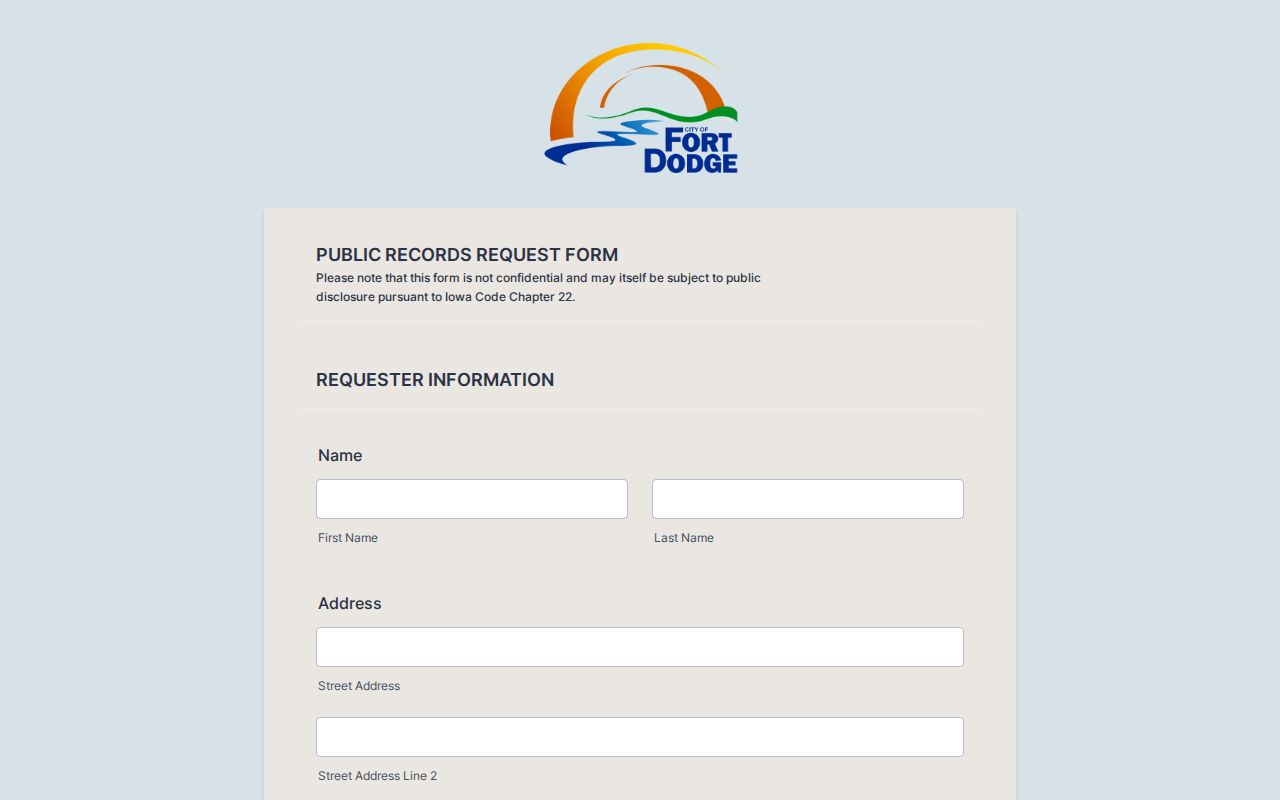
A useful Fort Dodge request states an incident number if known, approximate date and time, public location, document type, date range, and preferred delivery format. The city says production under 30 minutes is ordinarily free. It may quote staff time above that point and charge actual cost for a flash drive, disc, or other medium.
The city materials describe most records as potentially available the same day, while the current form warns of up to ten business days and no more than twenty calendar days. Those are response expectations, not a promise that every requested page is public. Juvenile, victim, active investigative, and other protected material may be removed.
Fort Dodge Arrests and Bookings
Fort Dodge Police arrestees are booked into the Webster County Jail in the shared Law Enforcement Center. There is no separate Fort Dodge city jail documented in the official research. FDPD controls its police report and local arrest-history product, but county jail staff control the intake record, present custody information, and booking photograph. Jail questions go to 515-573-1462, which is answered around the clock.
For a fresh event, review the Calls for Service interface, request the city report, and then contact the jail if custody occurred. A filed case may take about one business day to enter Iowa Courts Online. Readers who need the broader county process can use the Webster County arrest lookup without treating a Fort Dodge call entry as a completed case.
Fort Dodge Local Arrest History
FDPD's paper Local Arrest History is a special city product, not a general “background check.” It searches Webster County arrest records maintained by FDPD, excludes traffic history, and may not show the court's final disposition. It can also return an arrest or completed deferred judgment that needs careful legal context. Requests may be made in person or by mail.
The form asks for the subject's first, middle, and last name, date of birth, and gender. An optional Social Security number and other birth, maiden, adoptive, or alias names can help resolve identity. The authorization block supports release when required, including the form's special juvenile-record condition. Staff then record a found or not-found result and identify the preparer.
Local product limit: A Fort Dodge arrest-history response is not an Iowa criminal-history report, may lack a court disposition, and does not establish guilt.
Municipal Court Records in Fort Dodge
Fort Dodge has no separate conventional criminal municipal court. Iowa uses one unified trial-court structure. City-originated felonies, misdemeanors, ordinance prosecutions, and criminal traffic matters that reach court are handled in Iowa District Court for Webster County, with magistrates and district associate judges taking assigned lower-level matters.
| Court name | Iowa District Court for Webster County, part of Judicial District 2 |
|---|---|
| Clerk | Webster County Clerk of Court, 701 Central Avenue, Fort Dodge; 515-576-7115 |
| City case types | Filed ordinance, traffic, misdemeanor, and felony matters within the unified state court |
| Lookup channel | Iowa Courts Online, using Webster County, exact name or DOB, case ID, or citation as appropriate |
| Docket content | Public charges, filings, disposition activity, financials, and available documents |
| Older records | Contact the clerk for pre-1998, archived, confidential, or non-indexed material |
Do not send a court-record request to city police under chapter 22. The Iowa Judicial Branch and Webster County Clerk control the court file. A docket disposition, not the arrest label, answers whether the charge was convicted, dismissed, acquitted, or deferred.
Fort Dodge Calls for Service Records
The official Fort Dodge Police interface posts seven days of daily Calls for Service. It is a short-window activity source, not an arrest gallery or a full city crime database. Entries may be redacted where safety or privacy requires it. A listed call may end without an arrest, while an arrest report contains a different set of facts.
Use the log to identify an approximate event date, then ask for the police report. If the desired record is dispatch or CAD material, contact Webster County Telecommunications at 515-573-2323. If the person was booked, move to Webster County Jail. When prosecution follows, Iowa Courts Online becomes the place to track the filed case.
Where Fort Dodge Records Go
Fort Dodge police reports stay with the city department. A booking record moves through the county jail, while the Webster County Attorney makes the filing decision and the clerk maintains the resulting case. The court later reports qualifying dispositions to DCI. Fingerprints matter because DCI says it cannot create or add to a criminal-history file without them.
Record flow: Fort Dodge Police › Webster County Jail and Iowa District Court › Iowa Department of Public Safety, Division of Criminal Investigation
For very recent Fort Dodge activity, start with the city and jail. For the filed outcome, search the court. DCI is the official Iowa-wide history layer, not a substitute for a city report or a source for out-of-state and federal records.
A missing result at one Fort Dodge layer should not be generalized. A police call can exist without booking, a booking can precede the court index, and a court case can remain after current custody ends. DCI can also omit an event when qualifying fingerprints were not submitted or when release law restricts the information.
Fort Dodge Police and Sheriff Roles
Police and sheriff staff share the Law Enforcement Center at 702 First Avenue South. That convenience can hide the legal split between their records. FDPD handles its city reports and local arrest-history requests. Sheriff/Admin Records handles sheriff-created reports, and the county jail controls booking and custody records. One counter location does not authorize one unit to release another unit's file.
The official Iowa Public Information Board status report provides a system-level view of a Fort Dodge police-record matter. The image below comes from that official source and underscores that access disputes follow a public-record process rather than a commercial lookup channel.
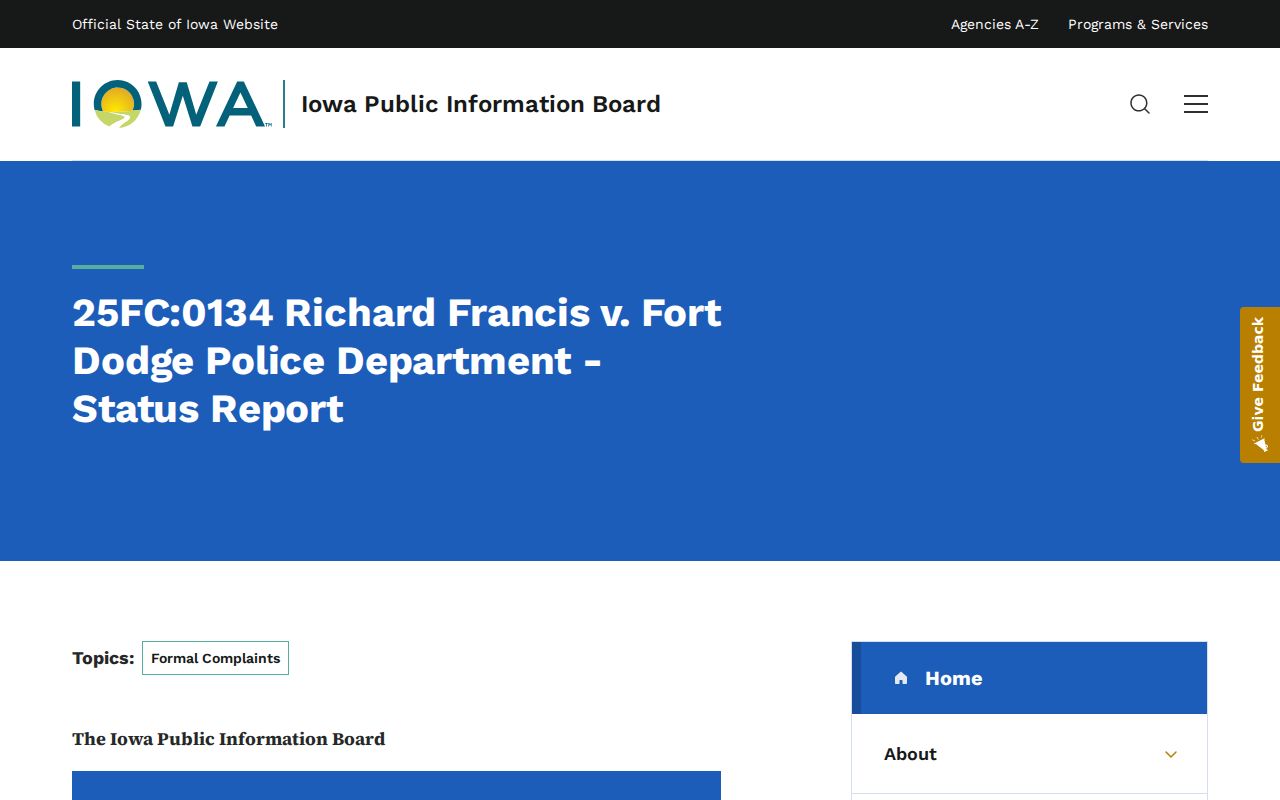
When an office redirects a request, identify the exact record and ask which agency has lawful custody. That question is more useful than assuming every Fort Dodge law-enforcement record sits in one database.
Fort Dodge Civil Citation Records
Fort Dodge's automated traffic enforcement material belongs outside the criminal-record chain. The city states that these citations are civil, carry no driver's-license points, and offer a municipal-infraction procedure that may be requested within 30 days. A city civil citation should not be described as an arrest or criminal conviction.
This distinction also corrects the phrase “municipal court.” A municipal-infraction challenge channel for a civil camera citation does not create a separate Fort Dodge criminal municipal court. Criminal cases still enter Iowa District Court for Webster County when prosecutors file them.
Public Access Rules in Fort Dodge
Fort Dodge police records are public only to the extent Iowa law permits release. The city may redact material tied to an active investigation, juveniles, protected victims, security, or other confidential subjects. Court records follow Judicial Branch access rules, and DCI history follows the narrower dissemination rules in chapter 692.
Key Statutes:
Iowa Code chapter 22 grants inspection and copy rights for public records while allowing lawful confidentiality and reasonable production costs.
Iowa Code chapter 692 defines criminal-history data, controls DCI release, and gives a subject rights to inspect and challenge a state record.
Iowa Code chapter 901C makes qualifying dismissed or acquitted case records confidential after statutory conditions are met.
A direct request should name the custodian and desired record instead of asking for all “Fort Dodge criminal records.” Narrow terms help staff locate the source and give a sound estimate without merging police, jail, court, and DCI files.