
Webster County Criminal Court Cases
The Iowa court system uses one District Court rather than separate city criminal courts. The Iowa District Court for Webster County hears felony and misdemeanor cases. Magistrates and district associate judges take assigned lower-level matters within that same system. A case arising in Fort Dodge, Gowrie, or Dayton therefore does not move to a distinct municipal criminal docket. The court assigns a type code and a 17-character Case ID that remains the key reference as the case moves.
The Webster County Clerk of Court is the practical custodian of filed criminal cases, dispositions, financial obligations, and older records that do not appear online. The Webster County courthouse is at 701 Central Avenue, Fort Dodge, IA 50501, and the clerk's phone is 515-576-7115. Police reports and county booking records remain with law enforcement. Once the prosecutor files a complaint or information, the Webster County court record becomes the best place to test whether an arrest charge was amended, dismissed, or resolved.
Webster County Criminal Case Codes
Iowa Courts Online groups Webster County cases with short codes. FE denotes a felony, AG an aggravated misdemeanor, SR a serious misdemeanor, and SM a simple misdemeanor. OW identifies an operating-while-intoxicated case. NT and ST are nonscheduled and scheduled traffic matters. CO and CY are associate court categories, while SW marks a search-warrant matter and PC identifies postconviction work. The code is a filing category, not a complete account of the charge or outcome.
Open the Webster County case before drawing a conclusion. The charge description, count, filing activity, and disposition supply the context that the two-letter code cannot. A filed charge may differ from the allegation entered during booking, and the final disposition may differ again. Readers comparing the initial custody event can use the Webster County arrest lookup process, but the court docket controls the filed prosecution and its result.
- Information
- A charging document filed by the prosecutor.
- Disposition
- The outcome or current resolution of a charge.
- Deferred judgment
- Judgment is postponed while ordered conditions are completed.
- Recognizance
- Release based on an unsecured promise to return to court.
Searching Webster County Case Records
Iowa Courts Online Search provides free basic public docket access for Webster County criminal court cases. Exact spelling helps with Webster County names. Name mode permits a percent sign as a wildcard, while exact-date-of-birth mode does not allow a wildcard in the first or last name. A Case ID search requires Webster County, the case type, and the correctly formatted 17-character identifier. Citation mode works from the number printed on the citation.
- Open Iowa Courts Online and choose the search mode that matches the information in hand.
- For a name search, enter at least two letters in Last/Firm and add the first name to narrow the results.
- Use exact DOB mode, a 17-character Case ID, or a citation number when those identifiers are known.
- Open the blue Case ID and review charges, public filings, disposition activity, and the financial ledger.
- Contact the Webster County Clerk for older material, courthouse-only documents, copies, or a record missing from the index.
The most useful Webster County search controls are summarized below. The official Iowa Courts Online help warns users to distinguish the number zero from the letter O in a Case ID.
| Field | Type | Required | Format or use |
|---|---|---|---|
| Last/Firm | Text | Yes for name search | At least two letters; exact spelling or % wildcard |
| First Name | Text | No | Initial has no period; wildcard allowed in name mode |
| Date of Birth | Date/text | Yes in DOB mode | Exact DOB with required first and last names |
| County | Dropdown | Yes for Case ID | Select Webster |
| Case Type | Dropdown | Yes for Case ID | Choose the matching criminal or related code |
| Case ID | Text | By search mode | Exactly 17 characters; letters uppercase |
| Citation Number | Text | Yes in citation mode | Use the issued citation number |
New Webster County Court Filings
A very recent Webster County arrest may not yet produce a Webster County court result. Iowa Courts states that a new case generally enters the index within one business day. Once indexed, case details update in real time. That timing explains why the jail or arresting agency may know about custody before a filed prosecution appears in a name search. It does not prove that the search failed or that no charge will be filed.
Check the spelling and search mode first. Then allow for the index window and try again. If the matter should be on file but remains absent, call the Webster County Clerk with the person's name and any known case, citation, or arrest details. Confidentiality can also keep a matter out of the public view. Juvenile cases, unexecuted warrants, presentence reports, and sealed documents are common examples of records that may not appear.
Note: A booking charge describes intake, while the prosecutor's filed charge and the court's disposition answer different questions.
Inside a Webster County Case File
A Webster County criminal case file joins the charging document to the Webster County docket events that follow. The online summary can identify the case, court category, creation date, indexed judge, public parties, and counsel. Charge entries can show the code, count, description, defendant, and disposition activity. Filing rows identify the event, filed date, comments, status, filer, and last update. The financial ledger may show fines, costs, restitution, surcharges, payments, refunds, and an amount due.
| Case identity | 17-character Case ID, case type, created date, title, and indexed judge. |
|---|---|
| Charges | Charge code, count, description, defendant, and disposition activity. |
| Filings | Event, comments, created and filed dates, filer, update, and status. |
| Parties and counsel | Public party names and lawyers where available, with protected information suppressed. |
| Financials | Costs, fines, restitution, surcharges, payments, refunds, and balances. |
| Documents and bonds | Public document links plus expanded bond data at a terminal or subscriber level when available. |
Bracketed public document links are free online. Some unbracketed documents need a courthouse terminal or paid subscriber access, and confidential documents are absent. The docket sheet should be read in date order. A charge row alone does not show whether the charge survived, and a dollar amount alone does not explain whether it is a fine, cost, surcharge, restitution, or an unpaid balance.
Webster County Court Filing Portal
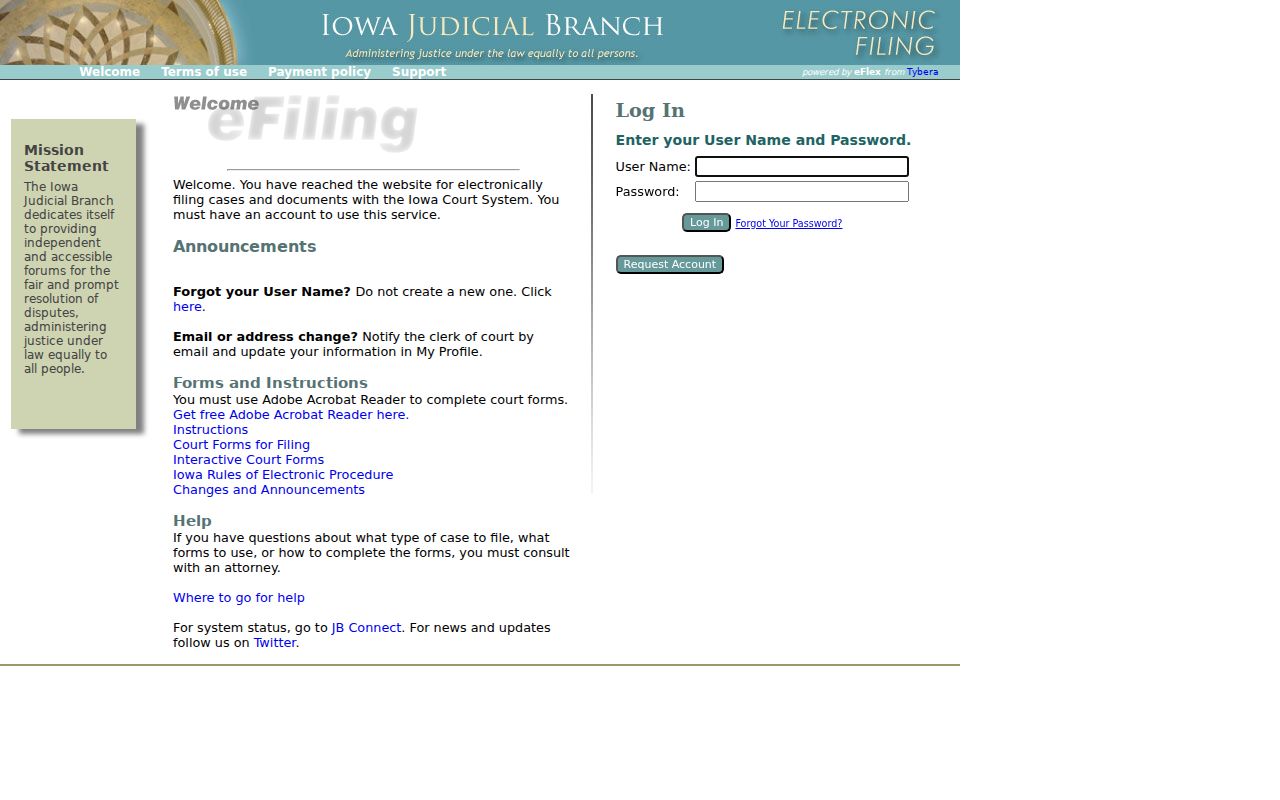
Iowa's Electronic Document Management System, or EDMS, handles electronic filing. The official EDMS sign-in page is separate from the public docket search. A person does not need to treat the filing account as a general case-search portal. Iowa Courts Online is the first stop for public docket review, while EDMS requires an account when a filing must be submitted.
The official sign-in screen shows how the court keeps public review and case filing as distinct tasks.
For a current form, filing fee, or case-specific instruction, ask the Webster County Clerk rather than relying on an old price or an unofficial form. The research did not establish a current universal copy or certification fee for publication. The clerk can also explain whether a filing belongs in EDMS or should be handled at the court counter.
How a Criminal Case Moves
A Webster County prosecution begins as a court case only after a charging step. Law enforcement may investigate and make an arrest first. The county attorney then decides what complaint or information to file, or a grand jury may indict. At arraignment, the accused receives the formal charge and enters a plea. Discovery and motions shape what evidence and legal issues can be used. A plea or trial produces the path to judgment, disposition, and any sentence.
Case flow: Charges Filed → Arraignment → Pretrial → Plea or Trial → Disposition → Sentencing
An appeal or postconviction filing may extend the record after sentence. The docket may also show bond events, service, scheduling, and financial activity. Dates vary by case, so no fixed Webster County timetable should be inferred from the process line. Read the actual docket and contact the clerk about a hearing that is not clear.
Webster County Adult Drug Court
Official Judicial Branch reporting identifies a Webster County Adult Drug Treatment Court with an OWI track. It is a county-specific specialty path for qualifying substance-use-related cases, not a separate court database. The underlying prosecution still belongs to the Iowa District Court record. Eligibility, participation, orders, and the final result must be read from the case and current program direction rather than assumed from the charge type.
A Webster County docket may reflect treatment-court activity through orders, hearing events, status changes, or disposition entries. The program name does not by itself prove that a person entered or completed it. When a Webster County record is unclear, the Webster County Clerk can identify public filings, while case counsel can address legal meaning. This distinction matters because a deferred or specialty-court path can end quite differently from the original charge.
Older Webster County Court Records
Public trial cases are broadly covered online after 1998. A Webster County criminal case from an earlier period may survive as paper, microfiche, or a local digital record even when a portal search returns nothing. Start with the clerk, give the most exact name and likely date range available, and ask whether the file can be inspected or copied. The courthouse counter or terminal may also expose public material that a remote view does not.
Do not turn an empty online result into a statement that no case exists. Name variation, a wrong birth date, a filing delay, an old record, or a confidential status can all affect search results. The clerk controls the court record, so a court-file request should not be sent as a general county Chapter 22 request to the sheriff. Iowa's court system, not the arresting agency, maintains the filed docket.
Note: Ask the clerk to confirm current copy costs and delivery choices before requesting a large or archived Webster County court file.
Case Record Access & Restrictions
Iowa law favors access to public records, but a court file can contain protected parts. Iowa Code chapter 22 supplies the general public-record framework, while court rules and specific laws govern Judicial Branch records. Confidential examples include juvenile delinquency material, unexecuted search or arrest warrants, presentence reports, protected domestic or mental-health matters, and documents sealed by court order. Public pages may also suppress protected personal data.
Under Iowa Code chapter 901C, qualifying all-dismissed or all-acquitted cases can become confidential after statutory conditions are met. A limited misdemeanor remedy also has detailed timing and exclusion rules. Expungement does not justify guessing about a missing result. The person seeking their own record should confirm the order with the clerk and, when needed, review the separate DCI history.
When a known Webster County case cannot be found, give the clerk the exact name, approximate filing year, and any Case ID or citation number. Ask whether the matter is old, restricted, or available only at the courthouse. The clerk may explain access and copy options but cannot turn confidential material into a public record.